19/10/2026

Chestnuts in Switzerland: From Bread Tree to Tree of the Future
At the end of October, Switzerland smells of roasted chestnuts, or «Marroni» as the Swiss call them. Our post on chestnut season covered Vermicelles, the horse chestnut and the roasting stalls in Swiss cities. Today we look further back: how did the sweet chestnut come to Switzerland, why did it once feed entire valleys, and why is it being planted again right now? At the end you will find tips for making chestnuts at home that are as good as the ones from the stall.
Across the Alps with the Romans
The sweet chestnut (Castanea sativa) originally comes from the eastern Mediterranean. The Romans brought it to Ticino together with the grapevine, because its fruit was nutritious and kept well. Pollen analyses show that the tree spread widely in Ticino during Roman and Lombard times, especially in periods when food was scarce.
The chestnut also took root north of the Alps, wherever a mild lake climate or the warm Föhn wind kept things warm: on Lake Geneva, in the Lower Valais, on Lake Walen, in the St. Gallen Rhine Valley and on Lake Lucerne. In the Middle Ages chestnuts were so valuable that monasteries collected them as a tithe. In Central Switzerland they are documented from the 14th century, and in years of crisis the Lucerne authorities even banned selling chestnuts to outsiders. Field names such as «Chestenewald» (chestnut forest) still recall this today.
Full stomachs before the potato
Before maize, beans and potatoes reached the Alpine valleys, the chestnut was one of the most important foods in Italian-speaking Switzerland, alongside barley, rye, oats and millet. Where hardly any grain grew on the steep slopes, it became the «bread tree» of entire valleys. For some Alpine valleys, consumption is estimated at up to 200 kilograms per person per year.
To make the harvest last until the next autumn, chestnuts were dried over a fire in small drying houses, then shelled and ground into flour. This was turned into bread, flatbreads and chestnut polenta. The whole tree was used: the leaves served as animal bedding and as filling for mattress sacks, the wood for vine stakes and rafters.
The decline began in the 19th century. The potato spread, and the railway suddenly made imported grain and rice cheap. Central Switzerland had another reason: in 1866 the Anglo-Swiss Condensed Milk Company was founded in Cham, later merging with Nestlé in 1905. Milk was in demand, so chestnut groves were cleared and turned into pasture. Where chestnut trees once stood, cows now grazed. In the 20th century, introduced diseases such as chestnut blight added to the pressure on the remaining trees.
Why the chestnut is making a comeback
What once confined the chestnut to warm spots is now its advantage: it loves warmth. With hotter summers it is seen as a potential winner of climate change north of the Alps, and models suggest it will spread across the Swiss Plateau. Sweet chestnuts tolerate heat better than many other tree species, grow quickly, soon provide shade and can live for up to 500 years.
The city of Zurich is therefore deliberately planting chestnut trees: in 2022 there were 64 sweet chestnuts on public land, today there are just over 200, including Zurich's first chestnut grove on the Hönggerberg. In Wädenswil, the Zurich University of Applied Sciences (ZHAW) is testing which soils suit the young trees best, because the chestnut does not really like the lime-rich soils common on the Swiss Plateau.
It is not a miracle tree, though. Long dry spells in summer also affect the chestnut, and ink disease, which attacks its roots, thrives in dry years. Large-scale dieback is already being reported from Ticino. That is why old groves are being cared for again: in Central Switzerland, the IG Pro Kastanie Zentralschweiz has been looking after the last groves around the Rigi since 2000 and has already restored or replanted many of them.
Day-trip tip: according to the events calendar, the Chestene-Chilbi takes place in Greppen on Lake Lucerne on Sunday, 25 October 2026. It is the largest market for chestnut products in German-speaking Switzerland, with more than 60 market and food stalls. If you like, walk part of the Rigi-Chestene-Weg trail through the chestnut groves of Weggis and Greppen beforehand.
How to make perfect chestnuts at home
Good chestnuts start at the shop: they should be plump, shiny and feel heavy in your hand. Dull, light or wrinkled shells suggest they have already dried out.
1. Score them
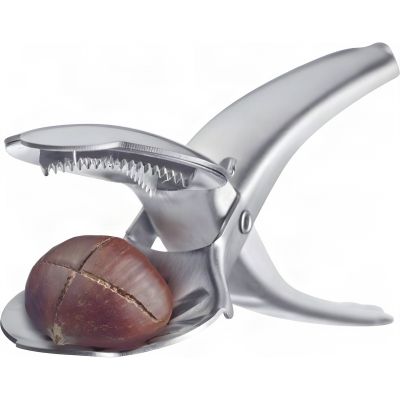
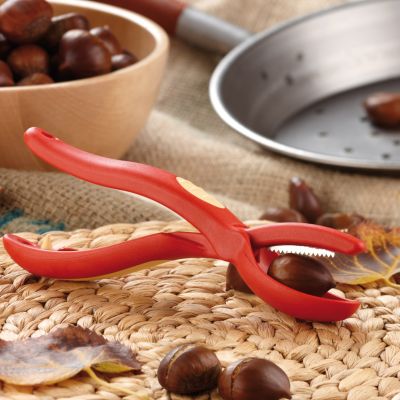
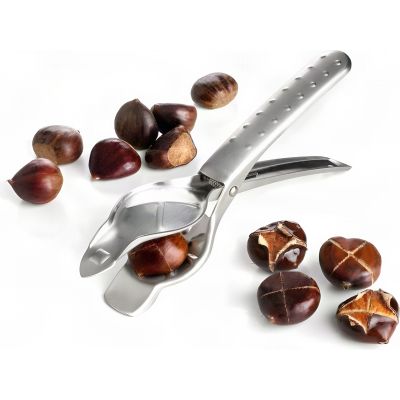
Without a cut, the shell bursts open unpredictably. Score each chestnut on its rounded side with a cross or one long cut, without cutting deep into the flesh. A kitchen knife easily slips on the smooth shell. It is quicker with the Chestnut Cutter Kastanietta: insert the chestnut, squeeze once and the cross cut is done. The tool then opens by itself. The Chestnut Cutter Pliers with Serrated Blade hold the chestnut firmly in a ridged recess while the serrated steel blade scores the shell. If you prefer a knife, try the Chestnut Knife Class with its non-slip handle.
2. Soak them
Before roasting, place the scored chestnuts in cold water for 30 to 60 minutes. This keeps them juicier while roasting and makes them easier to peel later.
3. Roast them in a pan
Chestnuts get the most flavour in a pan with a perforated base, because the heat reaches the shell directly through the holes. Our 26 cm chestnut roasting pan works on gas, electric and ceramic hobs. For induction, choose the blue steel chestnut pan: its base is closed, the ventilation holes run around the side wall, and it can even be used over embers. Toss the chestnuts every few minutes over medium to high heat until the shells darken and burst. Depending on size, this takes about 15 to 25 minutes.
4. Or in the oven
No pan? Use the oven: spread the chestnuts on a baking tray, add an ovenproof dish of water and roast at around 200 °C for 20 to 25 minutes. The steam stops them from drying out.
5. Let them rest and peel them warm
Wrap the hot chestnuts in a damp kitchen towel for a few minutes. The steam loosens the shell and the bitter inner skin. Peel them while they are still warm, because once cold the inner skin sticks again.
For soup, purée and Vermicelles: boil instead of roast
For chestnut purée or Vermicelles, boil the scored chestnuts in water for 20 to 30 minutes and peel them while warm. Raw chestnuts keep for about a week in a paper bag in the fridge. Cooked and peeled, they can be frozen, so they are ready for soup or red cabbage in winter.
Over a fire, in a pan or as a mountain of Vermicelles: a fruit that the Romans carried across the Alps and that brought whole valleys through the winter deserves a little attention. How do you like your chestnuts best?
Everything for your chestnuts
From scoring to roasting: our helpers for chestnut season.