
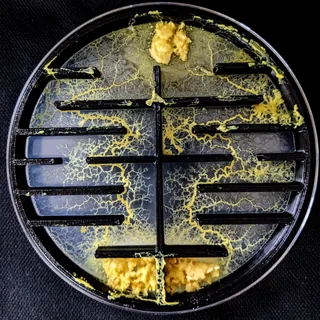
The maze
Build a simple maze inside the dish from narrow strips of plastic or card. Put the blob at one entrance and an oat flake at the exit. It fills every corridor first, then withdraws from the dead ends.
Topic page
No brain, no mouth, no eyes — and yet it finds the shortest way through a maze. The blob is a single cell that grows bigger than your hand. In 2019 the Paris Zoo put it on display like an animal, and since then it has been turning up in classrooms and on kitchen tables.
This page explains what the blob really is, how to keep one at home, which experiments actually work — and what to do when something goes wrong.
13 seconds of time-lapse, real footage. A sclerotium wakes up on the growing medium and spreads its network of veins — in real time this takes about two days. Footage: Mister Blob.
What it is
The blob is filed under slime moulds, but a mould it is not. It belongs to a group of its own that branched off early from animals, plants and fungi. That is why it fits none of the boxes we were taught at school.
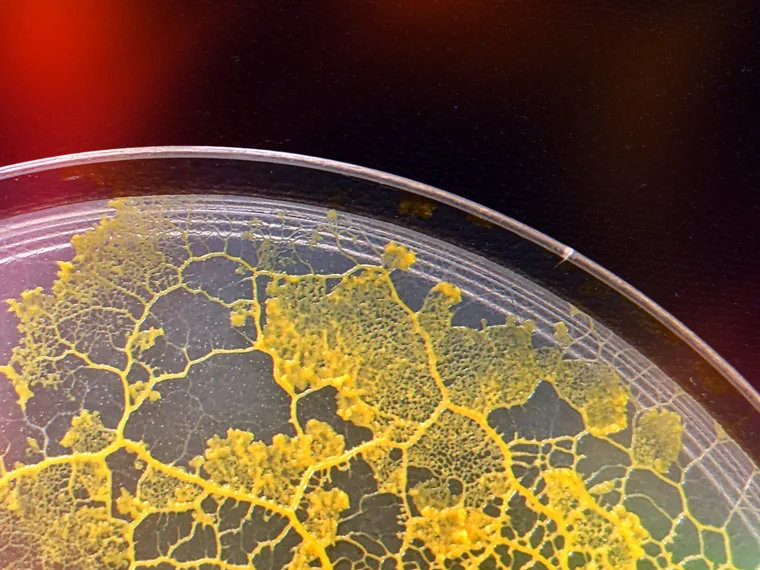
The most astonishing part is how it is built: what you see in the petri dish is one single cell. It simply has no internal walls and no single nucleus, but millions of them drifting in shared cytoplasm. The Latin name says as much — polycephalum means «many-headed».
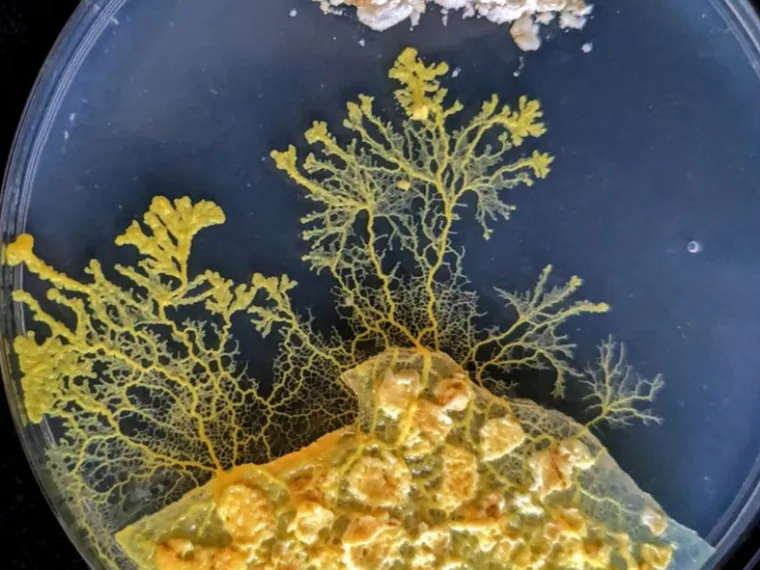
This cell moves by pumping its own contents around. Inside the yellow network the cytoplasm streams back and forth every few seconds, a little like a heartbeat without a heart. Where there is food, the veins thicken; where there is nothing to gain, they are dismantled. That thickening and dismantling is the whole trick behind its route-finding.
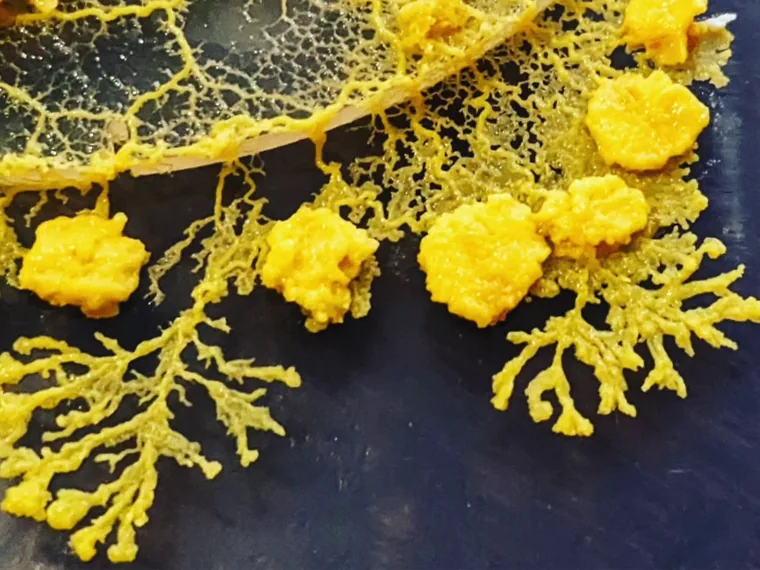
And it has two states. Moist and well fed, it is a plasmodium: the bright yellow network that grows and travels. As things dry out it contracts into a sclerotium — a hard, brownish crust. In that form it survives for years. A drop of water and a few oats, and it carries on where it left off.
Research
The blob would have stayed a footnote in biology had it not started solving problems no one expects of a creature without a nervous system. Four results made its name.
At Hokkaido University, Toshiyuki Nakagaki places a blob in a maze and puts food at two exits. The blob first fills every corridor, then withdraws from the dead ends, and in the end leaves a single vein standing: the shortest connection between the two food sources. Published in Nature.
The same discovery earns the team the Ig Nobel Prize in Cognitive Science — the award for research that «first makes people laugh, then makes them think».
Atsushi Tero lays out oat flakes in the pattern of the cities around Tokyo and places a blob where Tokyo sits. The network that emerges resembles the real railway system remarkably closely — at comparable total length, efficiency and fault tolerance. Published in Science; a second Ig Nobel Prize follows.
Audrey Dussutour's group in Toulouse puts bitter substances such as caffeine and quinine in the blob's path. At first it avoids them; after a few days it simply walks through: habituation, a recognised form of learning. And more than that — when a habituated blob fuses with an inexperienced one, the newcomer inherits the experience.
In October 2019 the Paris Zoo puts it on show in a vivarium of its own and gives it the name everyone knows it by today: le blob — after the 1958 science-fiction film.
Care
A blob needs less looking after than a houseplant. It has four settings — get those right and the rest takes care of itself.
Ordinary room temperature. Below 15 °C it turns sluggish, above 30 °C it goes to sleep.
It avoids direct sun. A cupboard or a drawer suits it best.
Agar holds water evenly — steadier than damp paper and slower to dry out.
A few oat flakes. Only add more once the old ones are gone.
Dissolve the agar in hot water as instructed, pour it into the petri dish and let it cool completely. The surface should set like a firm jelly — not liquid, not dry.
Place the sclerotium in the middle of the medium with the tweezers, moisten it with a few drops of water and put two or three oat flakes beside it — not on top, but a short distance away. Lid on, keep it dark.
After two to twelve hours the first yellow edge appears. From then on it moves quickly: overnight, half the dish is covered by a network of veins. Condensation on the lid is normal — a quick airing is enough.
Replace oat flakes once they are eaten and remove leftovers. Overfeeding is the most common mistake: whatever is left behind will go mouldy. Rinse and dry the tweezers before each intervention.
Want a break? Simply stop watering. The blob dries out slowly and contracts into a sclerotium. Keep it dry and cool — and wake it again weeks or months later.
The blob is the only pet you can put in a drawer before a holiday. Let it dry, take it with you or leave it behind, moisten it when you return — it carries on where it left off.
Experiments
Watching is lovely, but the blob only gets really interesting once you set it tasks. These six need nothing beyond the kit, some oats and a little patience.
Build a simple maze inside the dish from narrow strips of plastic or card. Put the blob at one entrance and an oat flake at the exit. It fills every corridor first, then withdraws from the dead ends.
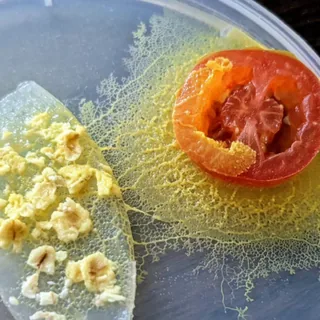
Lay three different things around the blob at equal distance — an oat flake, a piece of cucumber, a piece of tomato. Which does it reach for first, which does it ignore? Write the result down and compare with others.
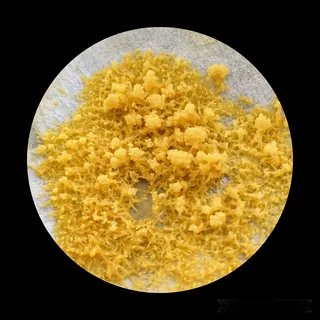
Cover one half of the dish with card and put it somewhere bright — not in direct sun. The blob migrates into the dark half. No eyes, no nerves, and still a clear decision.

Divide the blob in two with clean tweezers and put the halves back a few centimetres apart. Both keep growing — and when they meet, they fuse back into a single organism.
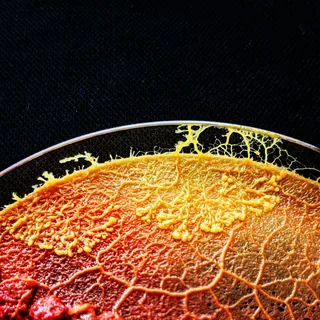
Lay oat flakes on the medium where Zurich, Basel, Bern, Geneva and Lugano sit on the map, and put the blob on Zurich. Then compare its network with the Swiss railway map. This same experiment, with Tokyo, won an Ig Nobel Prize in 2010.
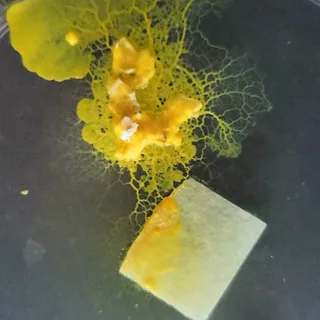
Phone on a tripod or a stack of books, interval shots every two minutes, lighting kept constant. After one night you have your own film — and you see movements that stay invisible to the naked eye.
Troubleshooting
Almost everything that can go wrong can be fixed. The most common cases:
The blob is harmless to people and pets. Even so, the agar and the oats are part of the experiment and not for eating. Younger children are best supervised — and wash your hands afterwards, as you would in a lab.
Frequently asked
Indefinitely. The blob ships asleep, as a sclerotium. As long as it stays dry, it waits until you feel like starting. There is no expiry date — a kit can sit in a cupboard for a year without trouble.
No. Physarum polycephalum is harmless to people and pets and is not infectious. It lives on oats and micro-organisms, not on us. Neither the blob nor the medium should be eaten.
From primary school age, and younger with help. Waking the blob is simple enough for children, and the watching grips adults just as much. In schools it is used from middle school up to upper secondary.
That is up to you. You see the waking and the growth in the first few days. Well looked after, the blob lives for months. If you want a break, put it to sleep and wake it again later — as often as you like.
The printed booklet in the kit is in French and English. The QR code inside leads to further language versions, including German and Italian. The kits are made in France.
No. Stop moistening it before you leave and it will dry into a sclerotium by itself. When you return, put it on fresh medium, moisten, feed — done.
It can crawl over the rim if it runs out of food or the light bothers it. Away from the moist medium, though, it dries out and crusts over quickly — it will not cause any harm.
Yes. Cut a piece off and place it on its own medium — both parts live on. Dried sclerotia can be sent in an envelope.
The blob makes a rewarding teaching subject: alive, harmless, pausable at any time and storable in any drawer. For class sets, purchase on account and individual quotes we have a page of its own.
Grow your own
The kit comes from Mister Blob in Montenach, Lorraine, and is made in France. It contains everything you need to start — the blob travels asleep as a sclerotium and waits until you wake it.

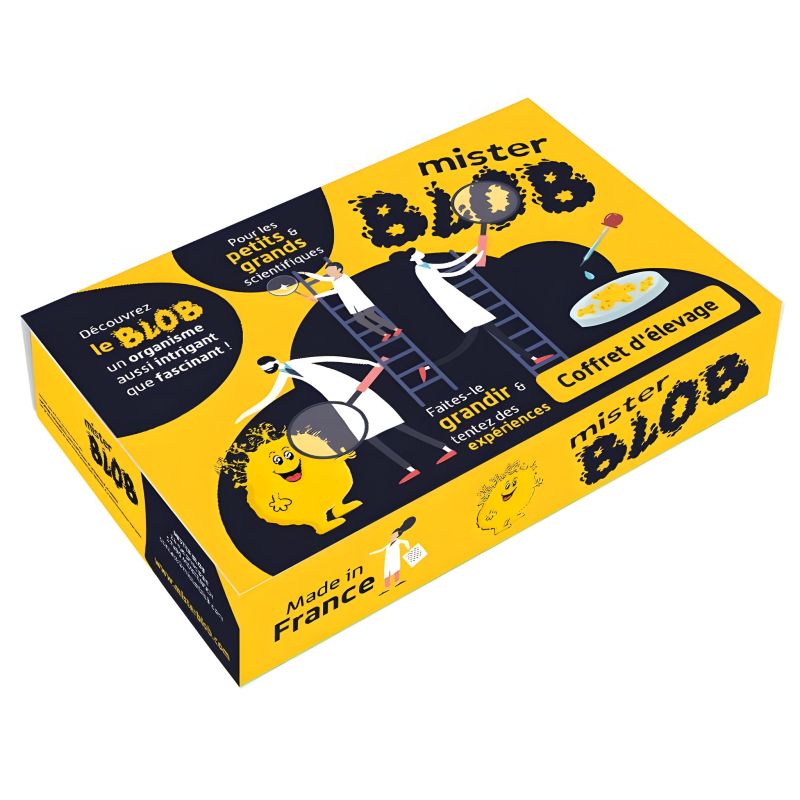
Mister Blob · Made in France
The «Malu» strain is robust and grows briskly — a good choice for your first blob.
CHF 29.95
View productIn stock in Kriens — order by 5 pm and it ships the same day.
Anyone who gets hooked on watching will find more kits here that follow the same principle: set it up, wait, marvel.

Mister Blob was founded by the biologist Morgane, out of a fascination with living things and their curiosities. The kits make observing Physarum polycephalum at home possible for everyone — for children and adults alike.


